

https://www.youtube.com/watch?v=SHsCkinrCPE
3
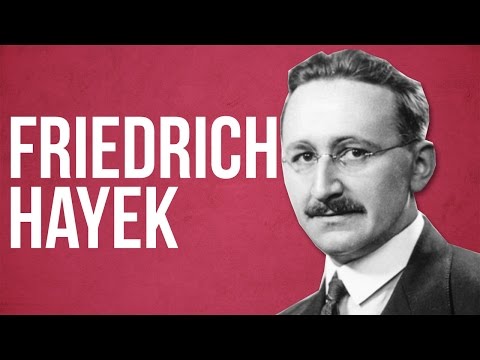
Friedrich August von Hayek (1899 - 1992), an economist with a 1921 doctoral degree from the University of Vienna, Austria, was interested in the causes of booms and recessions (trade cycles). In 1931, he claimed that not allowing money to be regulated by the market process caused economic instability. Today, most major economies now use floating exchange rates that are determined by the market demand for each currency.
Although, the USA and Britain had abandoned the gold standard (where the value of currency was fixed to the price of gold) by 1932, many governments tried to maintain fixed currency exchange (pegged) rates until late into the 20th century.
Hayek disagreed with John Maynard Keynes's theory that recessions could be cured simply by greater government spending. Instead he suggested that an increase in the money supply caused by a central bank's credit expansion (greater than the growth in the economy) generally caused inflation (a reduction in the value of money) and affected business cycles.
In 1937, Hayek proposed that individuals had only imperfect knowledge and it was impossible that any socialist manager could adjust prices when gluts or shortages appeared. In 1945, he argued that the price mechanism synchronized local and personal knowledge, permitting rapid adaptation to changes in circumstances. In 1944, he published The Road to Serfdom warning that attempts to centrally plan an economy (or to protect citizens from economic change) would reduce free choices leading to serfdom. Contrary to socialists' sincere promises of greater freedom, most studies found that socialism produced similar conditions to those under communism and fascism.
In 1945, he insisted that a monopolistic agency, like a central bank, could neither obtain the information necessary to govern the supply of money, nor be able to use such information correctly. He insisted that no planner, in a centrally planned economy, would ever have enough information to efficiently distribute resources. A free market was the only way distribute resources efficiently as the price mechanism automatically matched supply and demand.
The principle of spontaneous self-organization in economics led to his 1974 Nobel Prize.
He moved to the University of Chicago in 1950 where he wrote Law, Legislation, and Liberty.
He argued that 'social justice' was a meaningless phrase and there was no point in calling the outcome of the market just or unjust. Translations of his books, in underground and black market editions, greatly influenced intellectuals in the Communist Soviet Union arguably assisting in the collapse of the Soviet Union.
Hayek argued that a good society should have a comprehensive system of social insurance to guarantee people some minimum of food, shelter and clothing, sufficient to preserve health.
In 1988, Hayek attributed the beginning of civilization to private property and explained that price signals were the only way for economic decision makers to communicate in order to solve the economic calculation problem.
Hayek considered the free price system as a spontaneous way of exchanging good and services. It had evolved in the same way that languages were created. This idea influenced ecosystem research into complex networks of information with species replacing prices as the visible element.
Government interventions in the free market are usually well-meant but typically cause more problems. For one example. After Super-storm Sandy in November 2012, the mayor of New York, Andrew Cuomo, promised everyone 10 gallons of free gasoline. This immediately caused 4 hour lineups at gasoline stations and left emergency vehicles without fuel. Wage and price controls have also created more problems than they solved.

YOU ARE READING
Wealth
Não FicçãoAlmost everyone on the planet is five times wealthier than their ancestors only 50 years ago. This astonishing phenomenon has also improved health, education, and longevity. The average life span increased from about 40 years to more than 80 and t...
