

https://www.youtube.com/watch?v=CMQLdJa64Wk
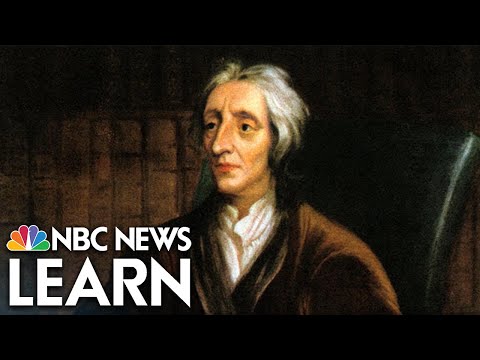
The founder of classical liberal political ideas, John Locke (1632 to 1704), lived through the British Civil Wars of 1641–1649 which resulted in the execution of King Charles the first. Charles was replaced by a republic led by Oliver Cromwell from 1653 to 1658. The new republic ended the Church of England's monopoly in favour of Protestant (mainly Puritan) religions. However, the protestant government was not popular and the conflicts continued.
Finally, after the Convention Parliament agreed, Charles' son returned from exile and was acclaimed by the London populace as King Charles the second on 23 May 1660.The last major outbreak of the bubonic plague (Black Death) swept through England between 1665 and 1666,killing 100,000 people, including 20% of London's population. In September 1666, the Great Fire of London destroyed most of the homes of the city's 80,000 people.
Locke studied at Oxford University and from the late 1660's and the early1680's he was aide and physician to the Earl of Shaftesbury.
Political and religious conflict resumed, from the mid-1670's, with many people challenging the authoritarian rule of King Charles II.
When the Earl of Shaftesbury became the leader of the political forces, attempting to limit the king's authority, John Locke drafted two 'Treatises of Government' in support of Shaftesbury's attempts, around 1680.But after the discovery of a plot to assassinate Charles II in 1683, Locke fled to Holland.
There he wrote, 'A Letter Concerning Toleration in support of resistance to the rule of James II' (who had succeeded his brother, Charles II, in 1685).
Locke returned to England following the Glorious Revolution of 1688, which established the precedent that an English monarch could not govern without Parliament's consent.
When both of his books were published, Locke rejected the doctrine of unlimited, unchecked, political authority, arguing that liberty, and not authoritarian control, was the basis for a peaceful and prosperous society.
He urged toleration of religious and all other peaceful activities, claiming that each individual possessed natural rights that everyone was obligated to respect. He argued that liberty included the right to develop one's economic abilities and to practice a freely chosen career and to acquire and use property without restrictions, provided any actions did not deprive others of their liberties.
He believed that social and economic order developed from the diverse desires, ambitions, knowledge, and capacities of the individuals and predicted that this would lead to a more complex, vibrant, and dynamic order far better than anything that might be imposed by social engineers and state planners.
Locke insisted that coercion, especially the use of physical force, was the enemy of liberty and was acceptable only to defend the liberty of individuals and the associations they voluntarily form. Hence, the classical liberal demand for radical limits on state power and action. Locke's work influenced Voltaire, Immanuel Kant, Jean-Jacques Rousseau and many Scottish Enlightenment thinkers like David Hume and Adam Smith. His contributions to liberal theory and classical republicanism were adopted for the United States Declaration of Independence.
https://www.youtube.com/watch?v=CMQLdJa64Wk choose stocks

YOU ARE READING
Wealth
No FicciónAlmost everyone on the planet is five times wealthier than their ancestors only 50 years ago. This astonishing phenomenon has also improved health, education, and longevity. The average life span increased from about 40 years to more than 80 and t...
